
Risk Management by Design: Doppler’s Approach to Off-Exchange Settlement

As artificial intelligence continues to advance, the cybersecurity landscape facing the digital asset industry is becoming increasingly complex.
AI-powered phishing, sophisticated impersonation schemes, and automated social engineering are making cyber threats more difficult to identify and defend against. At the same time, cryptocurrency exchanges, custodians, and financial protocols remain attractive targets for increasingly sophisticated attackers.
According to DefiLlama, cryptocurrency hacks and exploits caused $8.7 billion in losses in 2026 through November 1, highlighting the growing importance of robust security infrastructure and risk management across the digital asset industry.
These developments raise an important question for digital asset platforms: How can capital be deployed into financial markets while minimizing unnecessary exposure to security and counterparty risks?
At Doppler Finance, addressing this question begins with the underlying infrastructure.
Why Traditional Exchange-Based Trading Creates Risk
Many digital asset investment strategies rely on centralized exchanges to access liquidity and execute trades.
Traditionally, this requires transferring assets directly to an exchange, where they remain while trading activities take place.
While this model provides efficient access to markets, it also introduces counterparty exposure.
Assets held directly on an exchange may be affected by security breaches, operational failures, withdrawal restrictions, or insolvency events.
Even strategies designed to minimize market volatility, such as delta-neutral trading, remain exposed to these risks when capital is held by the trading venue.
For digital asset infrastructure to support increasingly significant amounts of capital, these risks must be addressed at the structural level.
Off-Exchange Settlement: Separating Custody from Trading
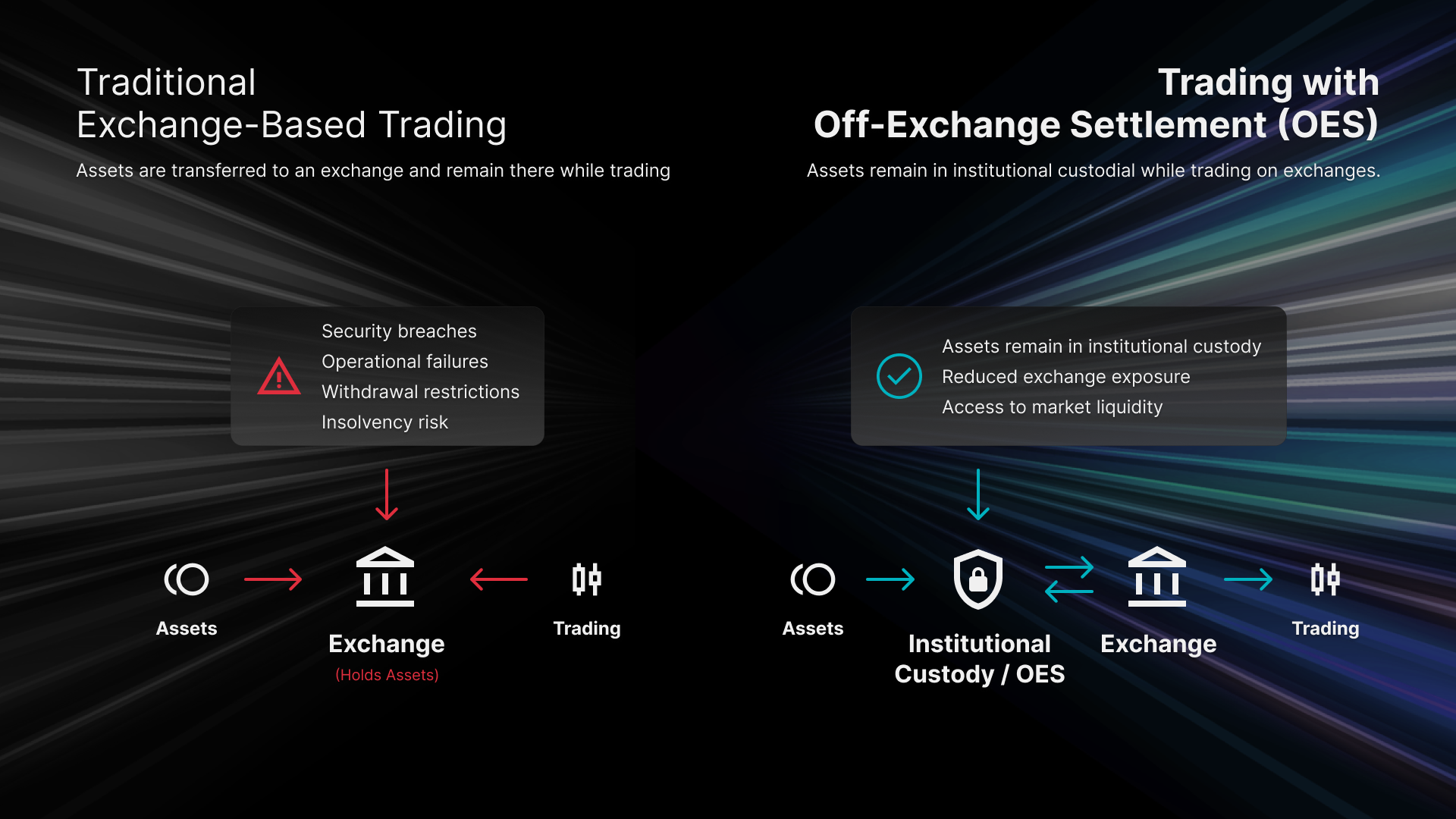
One approach to managing exchange-related counterparty risk is Off-Exchange Settlement (OES).
OES enables trading activity on supported exchanges while the underlying assets remain with a separate custody provider, subject to the applicable settlement arrangement.
When FTX collapsed in November 2022, it put a spotlight on the risks of keeping trading capital on an exchange. OES drew more attention from institutional traders looking to keep access to exchange liquidity while holding their assets elsewhere.
Rather than requiring trading capital to be deposited directly into an exchange wallet, OES allows eligible assets held in custody to support trading activity through corresponding exchange balances or collateral arrangements.
Trades are executed using exchange liquidity, while settlement is handled through the designated custody and settlement infrastructure.
This separation provides several important advantages:
- Reduced exchange custody exposure: Assets do not need to be held directly by the trading venue throughout the trading process.
- Institutional custody controls: Capital remains subject to the custody provider's security infrastructure and authorization procedures.
- Access to market liquidity: Trading strategies can continue accessing supported exchange markets without relying entirely on traditional exchange custody arrangements.
OES does not eliminate every counterparty or operational risk. However, it reduces a significant source of exposure associated with holding trading capital directly on exchanges.
How Doppler Integrates OES into Its Infrastructure
Doppler Finance incorporates off-exchange settlement into its yield infrastructure as part of a broader risk management framework.
Through institutional custody infrastructure, including Ceffu, Doppler is designed to support trading strategies while limiting the need to transfer underlying assets directly into exchange custody.
This structure enables Doppler to execute asset-neutral strategies across supported trading venues while maintaining defined custody and settlement arrangements.
Instead of relying solely on the security of individual trading platforms, Doppler incorporates custody controls and structured settlement processes into the operation of its vaults.
This approach is particularly important for strategies that require continuous access to exchange liquidity.
By separating asset custody from trade execution, Doppler seeks to reduce unnecessary exchange-related counterparty exposure without sacrificing access to the markets required for its strategies.
Security Extends Beyond OES
Off-exchange settlement is an important component of Doppler's infrastructure, but effective risk management requires multiple layers of protection.
Doppler's broader framework incorporates institutional custody infrastructure, MPC-based security, multi-signature authorization, trading partner due diligence, concentration limits, and ongoing risk monitoring.
These controls address different categories of risk, from unauthorized asset movement and custody vulnerabilities to trading partner exposure and operational failures.
Transparency is another component of this framework.
Doppler provides proof-of-reserves information and publishes periodic transparency reports to offer greater visibility into vault assets and operations.
Together, these mechanisms are designed to support a more controlled and transparent environment for deploying digital assets into yield-generating strategies.
Building Security into the Structure
As cyber threats become more sophisticated, security can no longer be treated as a feature added after financial infrastructure has been built.
It must be considered in how assets are held, how transactions are authorized, how trading activity is executed, and how exposure to third parties is managed.
No custody arrangement, settlement system, or security framework can eliminate all risks. Digital asset strategies remain subject to market, liquidity, operational, and counterparty risks, and neither principal nor returns are guaranteed.
The objective is therefore not to claim that risk has disappeared, but to establish infrastructure that identifies, limits, monitors, and manages it.
For Doppler Finance, off-exchange settlement is an important part of that approach.
As digital asset markets evolve, security must evolve with them. Building resilient financial infrastructure starts with designing risk management into the system itself.
Rebuilding Capital Markets for the Tokenized Era.