
The Next Step of Doppler: Building Decentralized Infrastructure

The Evolution of Institutional Financial Infrastructure
Digital assets are becoming an increasingly important component of global financial markets.
Stablecoins, tokenized real-world assets, tokenized funds, and other digital financial instruments continue to expand as institutions increasingly adopt blockchain-based financial infrastructure. The tokenization of financial assets is no longer a theoretical concept—it is becoming an increasingly important component of modern capital markets.
However, tokenization alone does not create functioning financial infrastructure.
Productive capital markets require liquidity, financing, collateral frameworks, risk management, governance, and transparent operational standards. Without these components, tokenized assets remain representations of value rather than fully functioning financial instruments.
The next phase of digital finance will be defined not only by the assets that become tokenized, but by the infrastructure that enables those assets to participate in efficient capital markets.
This is the opportunity Doppler was established to address.
Building the Foundation
Doppler began by building infrastructure for XRP and RLUSD.
XRP represents one of the world's largest digital asset ecosystems, while RLUSD reflects the emergence of institutionally-oriented stablecoin infrastructure. Together, they provided the ideal foundation for developing infrastructure that enables digital assets to become productive capital rather than passive holdings.
Through Doppler Vaults, we introduced transparent, structured infrastructure that allows users to deploy capital while maintaining exposure to their underlying assets.
Since launch, the protocol has surpassed US$100 million in total value locked expanded beyond XRP through RLUSD, and established strategic partnerships with exchanges, custody providers, and institutional organizations including SBI Ripple Asia, Evernorth, and Bybit.
These milestones validated more than product adoption.
They demonstrated that the demand for productive capital infrastructure extends well beyond a single asset or ecosystem.
Building infrastructure for XRP and RLUSD was the starting point.
The long-term opportunity is building decentralized infrastructure for the broader tokenized financial markets.
Why Decentralized Infrastructure Requires Governance
As financial infrastructure scales, so does the complexity of operating it.
Supporting a single product requires one set of operational decisions. Supporting multiple assets, lending markets, treasury operations, ecosystem incentives, institutional partnerships, and an expanding product suite requires a governance framework capable of evolving alongside the protocol.
As Doppler continues to grow, decisions become increasingly interconnected. Protocol parameters influence capital efficiency. Treasury allocation shapes ecosystem development. Incentive design affects network participation. Risk frameworks influence institutional adoption and long-term protocol resilience.
As these responsibilities expand, long-term protocol development should not rely indefinitely on a single organization.
Instead, it should progressively incorporate the participation of the broader ecosystem—including users, builders, liquidity providers, strategic partners, and other long-term stakeholders whose interests are directly aligned with the protocol’s continued development.
This is the next stage of financial infrastructure.
This governance model is inherently aligned with decentralized financial infrastructure. As protocols become more open, interconnected, and institutionally adopted, long-term development benefits from governance frameworks that incorporate the broader ecosystem rather than relying solely on centralized administration. Such a framework improves transparency, strengthens accountability, aligns incentives across participants, and enables infrastructure to evolve alongside the markets it serves.
For tokenized financial markets to mature, governance must evolve from an operational function into a core component of the infrastructure itself.
Building the Governance Layer
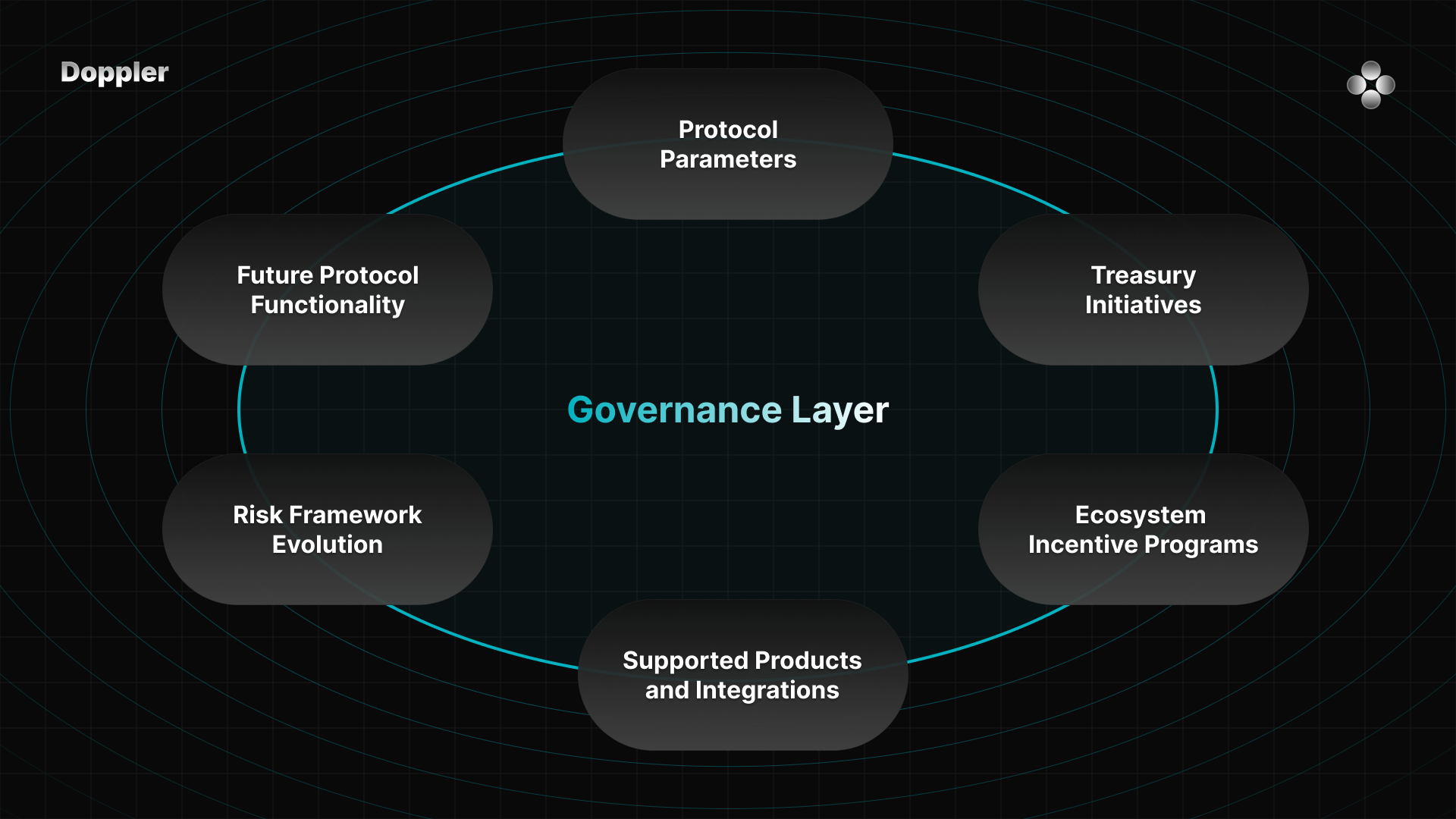
At Doppler, governance is not viewed as a single event or an immediate transfer of responsibility.
It is a long-term framework that enables the protocol to evolve alongside the ecosystem it serves.
Governance will be introduced progressively as the protocol continues to mature, providing participants with an increasingly meaningful role in shaping the future of the network.
Over time, governance is expected to expand across areas including:
- Protocol parameters
- Treasury initiatives
- Ecosystem incentive programs
- Supported products and integrations
- Risk framework evolution
- Future protocol functionality
This phased approach reflects the same philosophy that has guided Doppler from the beginning.
First, build resilient financial infrastructure.
Then, progressively expand participation as the network, ecosystem, and governance framework mature together.
Introducing $XDP

Supporting this transition requires a native mechanism that aligns participation across the protocol.
Accordingly, Doppler will introduce $XDP, the native utility and governance token of the protocol.
$XDP is designed to support protocol participation, governance, and ecosystem coordination while providing the foundation for progressively decentralized infrastructure.
Through governance, long-term participants will be able to contribute to the continued development of the protocol, helping shape ecosystem incentives, protocol parameters, treasury initiatives, and future infrastructure expansion as governance evolves.
$XDP is not intended simply as a governance token.
It is intended to serve as the coordination layer that supports the long-term evolution of Doppler as open financial infrastructure.
Looking Ahead
The first phase of Doppler focused on building infrastructure.
The next phase focuses on ensuring that infrastructure can continue to evolve through broader ecosystem participation.
Building decentralized infrastructure is not a single milestone.
It is a long-term process of progressively expanding governance, strengthening ecosystem participation, and aligning the protocol with the market it serves.
The introduction of $XDP represents the beginning of that next phase.
Additional details regarding $XDP including its utility, governance framework, tokenomics, allocation, and long-term role within the Doppler ecosystem will be announced in the near future.