
Doppler’s RWA Thesis: Building Modular RWA Infrastructure
The RWA market is one of the fastest-growing sectors in blockchain and onchain finance, with a wide range of market participants, from traditional financial institutions to crypto-native projects. As infrastructure supporting asset tokenization and issuance continues to advance, various financial instruments, including equities, government bonds, and funds, are increasingly being issued onchain. The RWA market has now reached approximately $40B in value.
Doppler is preparing for the next phase of RWA market growth, where the focus shifts beyond asset issuance toward enabling tokenized assets to be actively managed and traded, while driving broader participation across the financial ecosystem.
How Traditional Financial Products Operate: The Role of Financial Infrastructure
To apply the operating principles of traditional financial markets to RWAs, we outlined the lifecycle of financial products after issuance and the infrastructure required to support their ongoing operations.
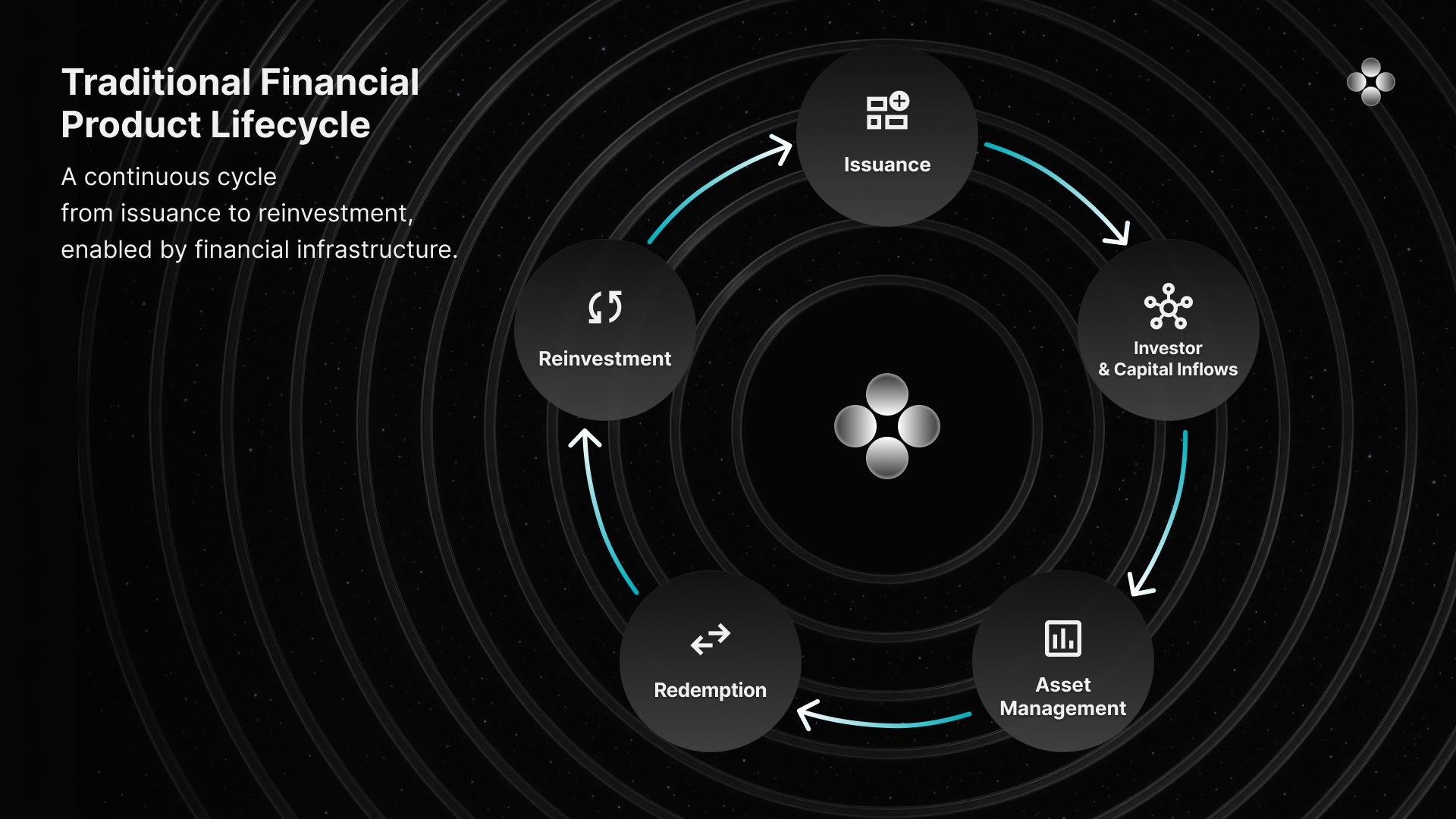
In traditional financial markets, the issuance of financial products such as equities, bonds, and funds is only the beginning of a broader financial lifecycle. Once issued, these products move through a series of stages, including capital inflows from investors, asset management, trading, and capital recovery. This creates a continuous cycle of Financial Product Issuance → Investor & Capital Inflows → Asset Management → Redemption → Capital Reinvestment. Financial infrastructure supports and connects each stage of this cycle, enabling capital to circulate efficiently throughout the financial system.
At the investor & capital inflows stage, brokerage and wealth management services, along with financial product distribution channels operated by banks and securities firms, connect investors with financial products. Compliance infrastructure, including KYC and investor eligibility verification, supports investor onboarding and access to these products. During the asset management stage, asset managers, custodians, and fund administrators provide essential functions such as asset custody, portfolio management, valuation, settlement, and accounting. Finally, at the redemption stage, stock exchanges, brokerage platforms, and market makers facilitate secondary market trading, allowing investors to buy and sell their holdings. For financial products such as investment funds, dedicated redemption infrastructure also enables investors to recover their capital.
Financial infrastructure therefore does more than just supporting the operations of individual financial products. It provides the foundation for financial activities to function reliably and systematically, from investor access and asset management to trading and capital recovery. By connecting these functions across the financial lifecycle, market participants can maintain regulatory compliance, manage operational risks, and build the trust and stability necessary for sustainable market growth.
Building Modular RWA Infrastructure
Doppler believes that financial infrastructure plays an equally critical role in the RWA market. For tokenized financial assets to function effectively beyond issuance, the financial capabilities supporting investor participation, asset management, trading, and redemption must be seamlessly connected throughout the entire lifecycle.
The financial infrastructure and operational procedures required to support RWA products beyond issuance are still taking shape. Building all the infrastructure needed to operate financial products independently requires significant time and resources, creating barriers to scaling new financial products and services.
To address these challenges, Doppler is building modular financial infrastructure that enables RWA projects and financial institutions to selectively integrate the capabilities they need. By modularizing the core functions required for financial product distribution, asset management and operations, liquidity, and redemption, Doppler aims to provide the infrastructure for institutions to build and operate RWA businesses with regulatory compliance, operational transparency, and efficient liquidity management.
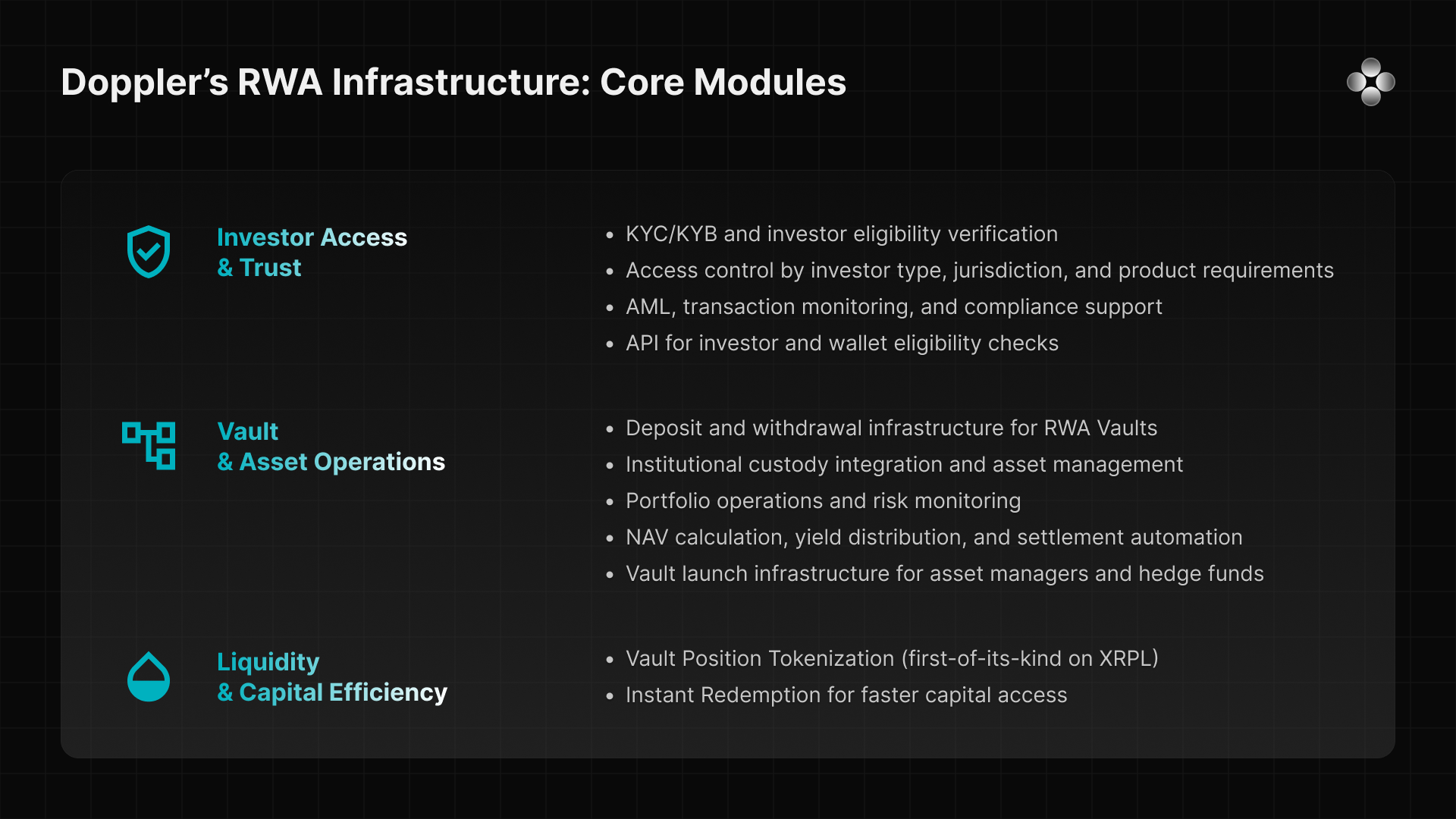
To achieve this, Doppler is developing three core financial modules aligned with the financial product lifecycle outlined above: Investor Access & Trust, Vault & Asset Operations, and Liquidity & Capital Efficiency. Each module addresses a distinct set of operational requirements and challenges, as outlined below.
1. Investor Access & Trust
Once financial assets are issued, infrastructure is needed to verify and manage investor eligibility and access to financial products before investors and capital can enter the market. In traditional financial markets, financial institutions verify investors' identities, investment qualifications, and countries of residence to ensure investor protection and regulatory compliance. Depending on applicable laws, the sale of certain financial products may be restricted to specific investors or jurisdictions. For example, certain private securities offerings under Regulation D in the United States require verification of accredited investor status, while securities regulations and economic sanctions may impose geographic restrictions (geo-blocking) on investors from certain jurisdictions.
The RWA market requires a similar level of investor verification and access control. However, blockchain transactions are conducted through wallet addresses, which alone do not reveal the identity, investment eligibility, or country of residence of the wallet owner.
For example, a tokenized private credit fund may only be available to eligible investors in certain jurisdictions. Even if an investor completes identity and eligibility verification during the initial investment process, transferring the fund's tokens to another wallet requires additional verification to ensure that the recipient is legally permitted to hold the financial product.
Without such verification mechanisms, RWA issuers may struggle to continuously enforce investor eligibility requirements and jurisdictional restrictions as tokenized assets circulate onchain, making it difficult to accurately identify and manage eligible token holders.
To address these challenges, Doppler is developing two core financial capabilities:
- Identity & Eligibility: Verifies investor identity and investment eligibility through KYC/KYB and eligibility assessments, linking the results to onchain wallet addresses. This enables institutions to determine whether a specific wallet is authorized to invest in a financial product, receive or hold tokenized assets, or request redemptions.
- Compliance & Monitoring: Enables institutions to continuously manage regulatory requirements for financial products in an onchain environment. This includes sanctions screening for investors and wallet addresses, jurisdiction-based access restrictions, transaction monitoring, and regulatory reporting. By integrating with token issuance and transfer control systems, it also enables institutions to enforce product-specific regulatory requirements, such as restricting asset transfers to wallets that have not completed the required eligibility verification.
Through these capabilities, RWA projects and financial institutions can integrate and operate investor verification, access management, and regulatory compliance infrastructure tailored to the requirements of each financial product, without having to build separate systems for investor onboarding and financial product distribution.
2. Vault & Asset Operations
Once investor capital flows into a financial product,its effective operation depends on the secure custody of assets, their management in accordance with the investment strategy, and the ongoing oversight of financial activities. In traditional financial markets, asset managers, custodians, and fund administrators support these operations by performing functions such as asset custody, portfolio management, valuation, settlement, and accounting. The infrastructure and technologies required to support these operations are already well established in traditional finance.
The RWA market is evolving in a similar direction, with the custody and management of underlying assets involving multiple systems, including traditional financial institutions, custodians, and external trading platforms. This creates a need for infrastructure that connects onchain transactions with offchain financial activities and provides integrated management of asset custody, investment operations, and settlement.
Consider, for example, an onchain fund that accepts stablecoin deposits from investors and allocates capital to tokenized MMF products. While investor deposits are recorded onchain, purchasing and managing the underlying assets requires integration with institutional custody providers and external financial platforms, as well as the management of trading and settlement processes for each asset.
In this process, the fund manager must distinguish between capital deposited into the onchain Vault and capital deployed into investments, while continuously monitoring assets held with custodians and outstanding settlement obligations. Since different investment products may have varying interest accrual and settlement schedules, the manager must also account for these differences when calculating the fund's net asset value (NAV), investor holdings, and returns. Additional deposits and withdrawals must also be reconciled with changes in the underlying portfolio to ensure consistency between onchain transaction records and actual asset movements.
Operating RWA financial products therefore requires infrastructure that connects onchain capital flows with offchain asset management, while providing integrated oversight of custody, portfolio operations, settlement, and accounting.
To address these challenges, Doppler is developing four core financial capabilities:
- Vault Operations: Provides the deposit and withdrawal feature required to operate financial products and manage capital flows between investors and Vaults. This includes processing deposits of various assets, such as stablecoins, verifying transactions and updating balances, handling withdrawal requests, managing withdrawal queues, and executing payouts.
- Custody & Treasury: Manages asset custody and transfers through integrations with institutional custody providers and external trading platforms. This module also supports security controls such as multisignature authorization (multisig), transaction approvals, and access permission management.
- Portfolio & Risk Management: Provides consolidated monitoring of portfolio positions and risk exposures across exchanges and financial platforms, enabling fund managers to assess investment performance and manage risks.
- Fund Administration & Settlement: Manages transaction settlements, accounting, and investor distributions, while reconciling onchain records with custody and exchange data to support NAV calculations and financial reporting.
3. Liquidity & Capital Efficiency
Infrastructure is also needed to enhance the liquidity of RWA positions and enable faster redemptions, allowing investors to access and redeploy their capital more efficiently. Although blockchain technology enables asset ownership to be transferred around the clock, the actual conversion of these assets into cash may still be constrained by the trading and settlement cycles of underlying assets, as well as the operating hours of traditional financial institutions.
To address these liquidity challenges and improve capital efficiency for RWA financial products, Doppler is developing two core financial capabilities:
- Vault Position Tokenization: Enables Vault ownership positions to be represented as onchain tokens that can be transferred or traded between investors. For example, an investor in an RWA fund with a lengthy redemption period may want to recover capital before the redemption process is completed. Instead of waiting for the fund to liquidate underlying assets or process a redemption, the investor could tokenize their Vault position and sell it on a secondary market.
- Instant Redemption: Enables investors to receive redemption proceeds immediately without waiting for the underlying assets to be sold and settled. For example, when an investor in a tokenized money market fund requests a redemption over the weekend or outside traditional banking hours, payment may otherwise be delayed until the underlying assets have completed settlement. Instant Redemption addresses this limitation by utilizing pre-allocated liquidity reserves or external liquidity providers to advance redemption proceeds to investors while the settlement of underlying assets takes place separately. This reduces the constraints imposed by traditional redemption and settlement cycles, allowing investors to access their capital and redeploy it into other investment opportunities more quickly.
API-Driven Integration & Expansion
To make these core financial capabilities accessible to external institutions, Doppler is developing an API-driven framework that enables RWA projects, asset managers, and financial institutions to integrate the financial modules they need directly into their existing products and services.
Through this framework, RWA projects and financial institutions can selectively adopt capabilities tailored to their business models and operational requirements, without having to independently develop systems for investor verification, vault operations, institutional custody, settlement, and liquidity management. They can integrate individual modules into existing services or combine multiple modules to build an operational framework suited to their financial products.
For example, an asset manager or hedge fund with its own investment strategy could leverage Doppler's Vault & Asset Operations infrastructure to launch an onchain investment product under its own brand. By utilizing Doppler's infrastructure for investor deposits and withdrawals, institutional custody integration, fund administration, and settlement, the asset manager could focus on executing its investment strategy and managing its portfolio.
Similarly, an RWA platform offering tokenized financial products to eligible investors could integrate the Investor Access & Trust module into its existing services. By linking investor identity and eligibility verification results to wallet addresses, the platform could manage access permissions and enforce token transfer restrictions, establishing investor management and regulatory compliance controls tailored to each financial product.
Doppler plans to expand this API-driven financial infrastructure across multiple blockchain networks. As part of the Doppler 2.0 roadmap, Doppler plans to expand into the Flare ecosystem in December 2026, followed by an expansion into the Canton ecosystem and the launch of RWA Instant Redemption in Q1 2027. Building on these milestones, Doppler will continue to develop the core financial infrastructure that RWA projects and financial institutions need to launch and operate financial products.